
A closer look at the GFiber
broadband label

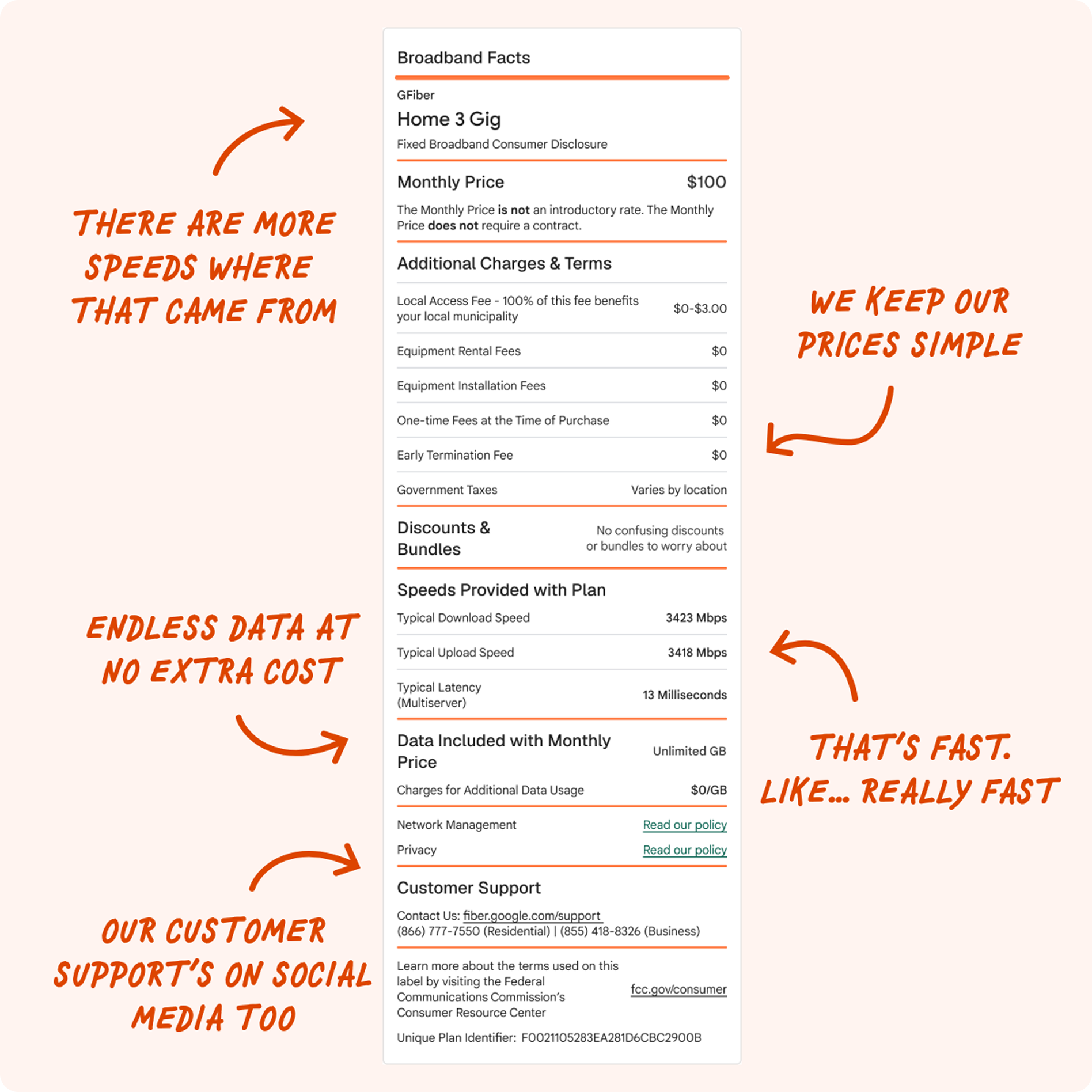
Everything you want to know about our internet — on one label.

Broadband Labels hero image - redesign

Why does internet need a broadband label?

To help customers better shop and compare services, the FCC requires all internet service providers to display their information on an internet “nutrition label.” GFiber was one of the first to launch our labels.

broadband-facts-label-v2

How to use the label

We know this label will make it easier for you to compare plans, but here’s a tip on what to look for when choosing the right service for you: upload and download speeds, equipment fees (some ISPs charge for this!) and pricing. It’s all right there in one place.

El Internet más galardonado,
Ahora reinventado.
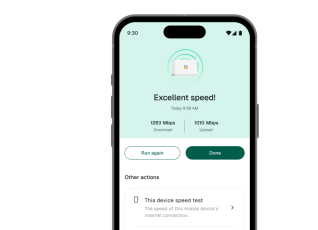
El más rápido de EE. UU.

Alcanza velocidades de hasta 8 Gig de descarga y carga. Es la nueva generación de velocidad de fiber que llega a tu hogar.
Inalámbrico, ahora sin límites

Wi-Fi 7 lleva la conexión inalámbrica al extremo. Obtén los equipos más recientes, la cobertura más amplia y velocidades de hasta 3.4 Gbps incluso por Wi-Fi.
Precios sin engaños

El mismo precio durante más de 13 años. Sin límites de datos. Sin cargos ocultos. Sin letra chica.
Experiencia galardonada

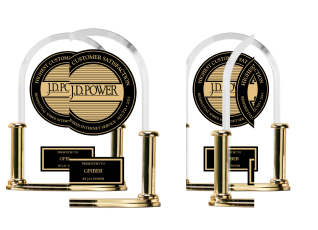
Elegida en 3 ocasiones por JD Power como la red de Internet con cable núm. 1 en satisfacción en la región sur, ganadora en 3 ocasiones del premio PCMag Readers' Choice, elegida como Mejor App y mucho más.

Preguntas frecuentes


You can find these files linked below.For Webpass broadband labels, click here.For GFiber broadband labels, click

here

.


Our typical download and upload speeds are based on internal tests and reflect the wired speeds that our network typically delivers to your home. The speeds indicated on our labels reflect the wired speeds achieved in our testing using a standard protocol and our latest GFiber-owned equipment, but are not guaranteed. Actual speed is impacted by many different factors and could be lower. Speeds are often measured in megabits (Mb) or megabits per second (Mbps). One gigabit is 1,000 Mbps, two gigabits is 2,000 mbps, etc. A higher number should mean that you can transfer more information every second.


GFiber allocates more bandwidth than advertised to accommodate system overhead and ensure the best experience for our customers.


The speeds published in the broadband label are internal test results for wired speeds. Speeds using internet on a wireless (Wi-Fi) connection are typically slower.


Latency (also called ping) is the reaction time of your connection — how quickly your device gets a response after you’ve sent out a request. A fast ping means a more responsive connection, especially in applications where timing is everything (like video games). Ping is measured in milliseconds (ms).Our broadband labels reflect multi-server latency, which is the average median latency to multiple off-network connections (i.e. Ookla, an industry-recognized third party providing analysis on internet performance). Multi-server latency is a better representation of a customer's experience as their connection pulls media and other information from a variety of locations around the internet.


Download speed measures how fast information can transfer to you over the internet. This affects things like how long it takes to download large files, update games or show pages with lots of photos.


Upload speed measures how fast information can transfer from you over the internet. This affects things like how you appear on video calls, how fast you can upload files to the cloud and how long it takes to add attachments to emails.


  • The speed of your internet plan
    • Higher speeds mean you can transfer more information every second
  • The type of equipment you’re connecting on — like your router, laptop, cell phone, etc.
  • How old your equipment is and its distance from the router
  • Wired vs. wireless connection
    • For faster speeds, hard wiring to your router will give you the best results
  • Walls and solid objects that may block signal
  • The number of devices connected at once
  • Interference from other devices (e.g. microwaves, cordless phones, baby monitors)

¿Quieres la mejor Internet?

Hablemos.